Wednesday, March 31, 2010

Blog Reflection 9 - Where does our sludge go....?


I am from Oakbank, Manitoba. I currently reside and work there, and we are part of the Rural Municipality of Springfield. I contacted our Utilities manager to get a bit more information that my general knowledge. What I know is that we have a lagoon East of town that can stink, but that is where our waste/treated waste goes. Here is the email from Greg Olson, Utilities Manager for the RM of Springfield:

Hello Alara,

All the houses and businesses in Oakbank, are hooked up to the public gravity sewer system. These series of underground pipes slope the sewage waste to a lift station. There are 4 lift stations within Oakbank. All these lift station pump the sewage to a main lift station, located on Springfield Road, about ½ east of PR 206. This lift station pumps the sewage to a lagoon located on Cedar Lake Road, just west of Willowdale Road. The design of the lagoon naturally treats the sewage. We can’t discharge the sewage between October 31st to June 15th of any year. Prior to discharge, we take samples of the sewage and test it for parameters required, and prescribed by the Province. If it meets those parameters, we then discharge the quantities that meet the parameters into the ditch on Willowdale Road. From here, it flows south to Cooks Creek Diversion, then west to the Floodway, which flows north onto the Red River, eventually into the lakes. We can discharge as often as we need to between June 15th and October 31st, provided the sewage meets the acceptable limits. One of the key issues about a lagoon is having enough storage to hold the sewage over the winter months.

This lagoon collected waste from Anola and Dugald too and also sewage from houses and businesses not on a public sewage system throughout the RM of Springfield, with holding tanks, or septic tanks. Previously, Oakbank and Dugald each had their own separate lagoon. These are no longer used, and will eventually be decommissioned.

If you need anymore info, let me know.


Greg

So I am not surprised really, as I mentioned, I have known bits and pieces about the lagoon etc. What I did not realize was that our lagoon naturally treats the sewage and that our town is very proactive in making sure that samples are continually being taken for our health and safety. I did not realize that the system was so elaborate (being pumped to all kinds of places and eventually to the floodway) and is also a "gravity" sewer system that flows to each life station. As of yet I have not heard of any overflow problems or flooding (Oakbank is higher in elevation than Winnipeg, so we would rarely ever flood) nor any outbreaks of E.coli in our water supply from this system. Considering that there is wildlife habitating on or around the lagoon (I have seen geese, birds, even a large Owl), there is concern for what is being flushed down our toilets and ending up in that lagoon. Though eventually everything ends up in the floodway, "stuff" along the way can be deposited (plastics, medication, etc) and left behind in that lagoon. Hopefully people in my town limit what the flush down the toilet and in the sinks, as we depend on that lagoon to function properly for our own health and safety.
Images taken by myself.

Saturday, March 27, 2010

The Great Pacific Garbage Patch

Watching the video about our the plastic being drained into the Pacific gyres was awful. It was like hearing about some wild phenomenon on the Earth, which it is, but not in a good way. The carcasses of the sea birds with their rib cages full to the brim of bottle caps was devastating, as well as the giant sea turtle barely living with the plastic band around it's body. If only something as tragic as the plastic could be cleaned as easily as flying over the area with a big net to collect the plastic pieces. There are so many things on this planet to worry about that it gets hard to distinguish what is most important or of higher priority. There are good people around the globe concerned about a great deal of things, and hopefully they will be joined by those that currently choose to live life as though these problems do not exist. The best thing to do at this point seems to be to get a hold on the land waste before it enters the waterways. Cleaning up plastics as much as possible before they drain out to the oceans. I am sure there are many that kill animals while en route to oceans, with as much devastation as there is with ocean birds and animals. It is hard not to feel defeated in the fight against all the bad that is happening. The big solution IS to smarten up and clean up after ourselves, which would hopefully have a rippling effect to stop climate change. If our goal is to get the Earth cleaned up, then success in that should allow everything else to fall into place.

Image 1 taken from http://www.resourceactionprograms.org/blog/wp-content/uploads/2009/04/great-pacific-garbage-patch.jpg


Image 2 taken from https://blogger.googleusercontent.com/img/b/R29vZ2xl/AVvXsEgjnttlCdks28bopKhmF2b4kpMy_H9ketTfQ3tNCZspU6mOnoXmK7soWYHQyCAnSCUkEfbaK2JVS3HEe36ClOezYTi8UVpqcnVlPiOiSN4HYih_Sf3NS8JJxOHXF5XzMgtUoIuLHZKwPw/s1600/6a00d8341c713953ef00e55195c7488834-800wi%5B1%5D.jpg


Image 3 taken from http://www.hopeforgaia.com/wp/wp-content/uploads/2008/11/watergarbage.jpg

Monday, March 22, 2010

Ice Shacks...phooooey!


On the news the other night as a little story about all the crap (literally) left on the Red River from the ice shack dwellers during the winter. Adults left garbage, human poop, whole ice shacks, and more on the ice to either be cleaned up by someone else or to just drop into the river. How disgusting! It's enough that we have to deal with polluted waters from agricultural run off or other unseen pollutants, but grown human beings are acting like idiots. I think they should be fined or lose privileges for a winter with no chances. People know not to leave campsites that way, how would this be different? I don't think people toss their garbage into the water while they fish in the summer, so why do it in the winter? It is aggravating to a lot of people, and the fact is the shacks are being used by grown people that should know better. I also wonder why ice fishing doesn't have people (such as conservation officers) to monitor that. In campgrounds you are asked to clean up your site if it's left messy. Damage deposits are taken at hotels for the unruly person, as well as at some (or all?) campgrounds. Ice fishing should be treated in the same way, and hopefully people will smarten up, as WE are greatly effected by their pollution and stupidity.

See the below link from CTV news for the video I am referring to.

http://www.ctv.ca/servlet/an/local/CTVNews/20100317/wpg_litter_river_100317/20100317/?hub=WinnipegHome


Image 2 taken from

Sunday, March 21, 2010

David Suzuki talk


"It's the Environment, Stupid!"


An interesting talk from David Suzuki and Sir Nicholas Stern. Both discussing a common knowledge but trying to drive the point home. People are concerned about what environmental action will do for the economy now, instead of what environmental INaction will do for the economy in the long run. The plain answer was to take care of costs now or else suffer major consequences that may be irreversible in the future. People do not want to put forth the money now, whether we are talking about the global scale or making personal changes toward becoming 'eco-friendly'. When people hear the costs of alternate energy sources such as solar power or wind turbines, they stop listening without realizing the long term cost savings and benefits. On the global scale it is much the same, only the countries around the world are replacing the thoughts of individual people. Even Canada is having troubles leading the way to saving the planet and the people on it. I think that taking care of the place we inhabit should be number one priority, and the rest (ie, economy) will follow or adapt.


Thursday, March 18, 2010

Sustainable Urbanism


The other day we had a guest speaker in talking about sustainable Urbanism. I found it great, because I am planning on focusing my studies on green building etc. It would be amazing to have the experience that Dustin was talking about, while living in the city. It would be great to have everything within walking distance and to have a real community feel. I am from a small town just outside of Winnipeg, and almost everything I need is accessible within walking distance. I constantly see neighbours and friends if I'm out biking or walking, and we have many parks and trees. Realistically, I am not close to everything that I wish to be, and living in Winnipeg would be a lot easier. I have worked downtown on Broadway, and it might not be quite what Dustin was talking about, but I found even the lush trees that lined the street refreshing on my lunchhour, but other than restaurants there was not much else that was close by. The Forks was great, but as Broadway is such a heavily trafficked area (car and foot), it was hard to enjoy any green space or community feel. Accidents between vehicles and vehicles and vehicles and pedestrians were very common, and most people that were about on Broadway were employees from nearby office buildings, hot dog vendors, or hot dog vendor protesters.

I would think it would be very difficult to incorporate these factors discussed (such as the compacted community with increased foot space) without affecting vehicle traffic. In places such as the Exchange district this currently exists somewhat, but people definitely prefer to drive through all the many roads that surround main street. To eliminate them or reduce them would be great, but would cause huge redirection of traffic. Similarly, it would also be a big task to make the change in an existing neighbourhood. It is common to see wasted buildings and sites in Winnipeg that would be incredible to transform, however, how do you push back existing people or crime while making the change? It would be interesting to be a part of the planning process for one of these projects and be able to witness implementation start to finish (or as closed to finish as possible).

Summary - Selection 24

Restoring Rivers by Margaret A. Palmer and J. David Allen

"Life on Earth is utterly dependent on water. Life on land requires clean, fresh water." Unfortunately, there are still many water problems that are to the point of river "extinction." A major fact in this article was that at least 1/3 of rivers in the United States are "impaired or polluted." Above human influence, natural disasters also are contributing to degradation of river and water systems which in turn affect marine, plant, and animal life. People need to come together for a common goal, as the tendency for humankind has been to reside near water. Our appreciation for the support from waterways has been to pollute and dump our junk into them. Other alterations such as dams and highways have also been major contributors to the damage we've done, and in many cases degradation has become irreversible.

Solutions have been to plant riparian buffers and enforcing storm water programs for reduction of pollutant discharge. Like many ecological programs, people and the government harmonize in some way. Joint efforts are always the driving force for change. Unfortunately, billions of dollars have been spent on river and stream restoration, but because there are no policies to support effective restoration, the efforts made are failing from poor planning and implementation. There needs to be national standards with the proper tools and information for each project so that money does not go to waste. Sites need detailed monitoring and better coordination, and in doing so benefits such as flood control, protection of infrastructure, maintenance of water quality, jobs, and lowering of taxes. Without fresh water, we cannot survive nor can we take it for granted. Combined efforts from scientists, environmental groups, and individuals are needed for the U.S. to restore and protect the waterways of America.

Summary - Selection 23


Controversy at Love Canal by Beverly Paigen

Love Canal was a residential area in New York that was built on top of a hazardous waste dump buried underground. The waste was disposed by a company called "Hooker Electrochemical Corporation", which was a company that had little responsibility in outcome of the hazardous waste being buried and covered up. Paigen writes about her own personal studies on the outcome of many residents of Love Canal. Twenty-five years of over 21,000 tons of 200 or more chemical waste seeped into the bodies of the people, including the unborn. Miscarriages were common, as well as many birth defects (low birth weight, missing limbs, heart defects, deafness and many more), toxicity in the central nervous system, and many more in homes classified as "wet" homes. Wet homes were homes located nearby streams, ponds or swells. There were also the "dry" homes that were further away. Studies were conducted comparing any differences between the sicknesses and defects from the people living in either types of home. Typically the wet homes had more problems, yet there were still harmful effects in some dry home residents.

Among the illnesses, people also suffered antagonism between the community and the health department. The people in the community felt that the knowledge of the hazardous waste that the health department had and did not share or "own up to" placing the blame more in their hands as opposed to the Hooker corporation. It seemed very difficult for people to get a voice or for anybody to claim responsibility over the awful side effects that people were having from inhaling or existing among these chemicals. The astounding abnormal events that happened to these people did not put a rush on helping the people or taking the blame for what was happening to them. One hundred miscarriage did not seem convincing enough to shut down the town and help the people.

Eventually there were charges laid against the state agencies, for reasons such as manipulating health data, delaying admission of the existence of a health problem, consequences to employees that were sympathetic to the suffering Love Canal residents, and their effort to discourage independent professional health studies that would make them look bad. Many things were learned from the faults of the state in tragedies such as Love Canal, where ethical and scientific issues were poorly executed.

Summary - Selection 39

Towards Sustainable Development by World Commission on Environment and Development

Meeting the needs of future generations as well as our current needs, sustainable development should be a high priority on a global scale. If we can succeed in sustainable development we are ensuring a better life for our future generations. Keeping within the bounds of the ecologically possible we still need to consider social and culture needs for each part of the world. Productivity and equitable opportunities also comes in hand with distributing resources depending on population size. We cannot danger our natural systems in enforcing sustainable development, but to work with them in a ways that we do not deplete them rapidly or abuse our privilege of using them. If we deplete resources such as forests too quickly, we may not be able to replenish in a timeline allowing for re-growth.

Problems arise because areas requiring action do not always coincide with political jurisdictions. Similar zones that cross two states or countries may have different policies on what "being sustainable" is, leading to major inconsistencies in trying to encourage sustainable development. Common interest is key, but difficult as the solution must make everybody happen and work for the Earth as a system whole. Because there are difficulties in promoting sustainable development with a common interest it is often neglected through areas of economic and social justice. There needs to be an enhancement in current technologies and extension of these technologies to the third world as to level off the playing field. On top of that, past failures need to be considered during technology design to reduce failure.

Communities need the knowledge and support in order to "upgrade" to a sustainable lifestyle. Involving the public is usually a good idea when you are trying to make alterations to lifestyles, especially if for the better. The authors of this reading also believe that free access to information and to have alternative resources available to them can help greatly. Public and Private sector enterprises also need to change and move beyond the typical safety inspections, environmental objects, zoning laws, etc. Promoting harmony and health among human beings should be the main priority of this world, and it is required for political members to be able to provide for their people which would include the sustainable development practise that will hopefully ease problems for our future generations.

Blog Reflection 8


Affluenza...where to begin? I am definitely guilty, because I have a lot of "stuff". I know that I am slowly getting "better", but society makes it tough to ignore all the "pretty, shiny" new things. There are always upgrades and new models that are so appealing. I do try and vow that things like phones and iPods should only be upgraded if broken or stolen, or my contract is up. It is in my family, as I have 3 sisters. My mom and one of my sister's is okay for it, but I know the other two enjoy some of the "finer" things like I do. I quote "finer", because perhaps they aren't really symbols of what is considered a finer thing in life. Like we discussed in class, affluenza is just "stuff" that means nothing and usually leaves you wanting more, more, more. In North American society Affluenza is taking over. As I mentioned, there are always new upgrades to everything. Items get smaller and more streamlined, touch screened, updated styles in clothes and technology....we are in a society that is constantly in the pursuit of MORE. How can it be combated? I supposed the concept of "living green" is something that can be used. The sense of reusing things, recycling old items, giving purchases that second thought. Is it really something I want or actually need. Sustainability goes hand in hand with combating affluenza, because if we can work to be green and control our impulse buys and upgrades, we are reducing waste old, current, and future products. We are reducing CO2 emissions and other harmful pollutants that are emitted into the atmosphere or into an ecosystem from the production of those goods. In spending time with our families out doors instead of buying things, we are promoting a better healthy lifestyle as well as a greater connection with the outdoors. To try and live green could work! Society just gets faster and faster with technologies and styles, and we need to slow it down by not responding so quickly and practising our three R's. Reduce, Reuse, and Recycle!

Wednesday, March 10, 2010

Food, Inc.

Food, Inc. by Robert Kenner

Another film that is almost regrettable to watch. The information in this film is great to know, but do we really WANT to know about the foods we are eating? What has come evident is that the food industry is a huge power that is not afraid of attacking "the little guys." are being drained of their livelihood and in come by the "big guys", the worst being Monsanto. Monsanto has come up a lot in class discussions, including the independent film "Seeds of Change." The University of Manitoba houses the head office of Monsanto in Canada. Why are we accommodating these people that have little regard for peoples health or well being? It is almost as terrifying as the power that oil companies have over our country.

Chickens that are being bred so quickly that their "breast enhancements" happen quicker than their internal organs and bones can keep up with and they either suffer and die or cannot even walk. They are being kept in dark sheds and quality of life is completely disregarded. They just lie their and wait to be butchered in a production line. The diets of cattle are altered to "cheap" corn instead of grass, which has been a huge cause of the E.coli outbreaks that are killing people and even getting on vegetables. Simply changing the cows diet back to grass can eliminate the bacterias such as E.coli. I wondered about all of the carcasses of the wasted meat of cattle that died of disease or poor living conditions are a waste of the GHG emissions they produced during their lives. Nothing resulted out of it, nobody was fed, and those that do survive can carry disease. Ammonia is being used to kill the E.coli, and meat "fillers" are also used for the hamburgers that we are eating.

Promoting the "dollar menu" concept has been why this is happening. Right from the beginning, McDonalds was a HUGE part of this speedy and unhealthy way of life we have adopted. They wanted hamburgers everywhere to taste the same and were clearly very successful in doing so. Families can easily afford the cheap dollar menu fast food as opposed to going to the grocery store and purchasing vegetables and other healthy options. The problem is that in doing so, we are trapping ourselves in a viscous circle. Health problems start to arise (diabetes) and medication is required to maintain our health. People that cannot afford medication as it is, are still forced to continue on the "cheap" and "speedy" diet of this so-called meat.

A major point of this movie is for people to become aware, to ask questions and to gain knowledge on their own about the foods they are eating. We are entitled to know what is going in our mouths, but not everything is required to be on the labels. Beyond the labels we don't realize that the people that are processing our meat are "human machines" as stated in the movie, and mostly illegal immigrants. Poor wages, poor working conditions, and people were being arrested and hauled away, but the companies that hired them that were fully aware of their illegal status probably did not receive even a slap on the wrist. They were being treated like the hogs they were slaughtering.

"People" along the way that contributed to our way of life has been the Bush Administration, Monsanto, McDonalds, and many many others. They are extremely successful in what they are doing and somehow can go after the little people and get away with it. At the very end of the film they discussed how there is hope going against these food corporations that seem to win everything and get away with everything. They compared the battle against the food corporations to the battle that was fought against tobacco companies. Smoking has been banned from all indoor facilities (excluding reserves), tobacco products are being hidden from sight in stores, they are properly labelled with their toxic ingredients, as well as the surgeon generals warning and pictures right on their packaging. We should know what is in our food and understand what it is that they are listing on those packages. If the soybeans that are in our food are "round up ready" we should know exactly how that modified the seeds. Ingredients on websites are probably not always accurate, and people don't always want to do the leg work in researching their food. What is the simplest solution would be to eliminate all these GMO's and to stop the mass production of chickens and cows and pigs. As suggested in this film and many other discussions, we should go back to traditional practises and step away from this quick paced food production.

Image taken from http://gatheringinlight.com/wp-content/uploads/2009/11/Official-Food-Inc.jpg

Summary - Selection 29

Environmental, Energetic, and Economic Comparisons of Organic and Conventional Farming Systems by David Pimentel et al.

This article gives comparisons between organic and conventional farming, of different kinds to do so. Using different kinds of cropping and also experimenting with weather conditions etc., Pimentel gives a comparison of the results. What he is weighing on is the price of human health vs. the conventional herbicide, synthetic fertilizers as opposed to using legumes or animals to crop. Ultimately, the environmental and health benefits for organic techniques reduced chemical inputs, there was less soil erosion, more water conservation, and improved soil organic matter and increased biodiversity. Even less fossil fuels were being used, reducing the amount of carbon dioxide released into the atmosphere. Weed control is also something that is factored in, and instead of using chemicals, mechanical Though Pimentel points out that organic corn and soybeans tend to be higher priced than conventional corn and soy beans, in the long run health shouldn't be sacrificed for price. There is also a potential for higher economic returns for the organic produce.

With organic technologies comes many beneficial things. In Pimentel's list are the benefits such as extended crop rotation which conserves both soil and water, and even reduces insect, disease, and weed problems. An increased level of organic matter in the soil also helps to conserve water resources, and in general there is increased biodiversity. Using any of these technologies increase the ecological, energetic, and economic sustainability of agricultural systems in general. Pimentel came to many conclusions with his studies, and all were beneficial to sustainable agriculture development.

Tuesday, March 9, 2010

Summary - Selection 41

Women's Indigenous Knowledge and Biodiversity Conservation by Vandana Shiva

Vandana Shiva makes an argument for the unrecognized women of the farming industry. Using their natural abilities to nurture for the argument, Shiva believes that because women can work multiple tasks, including sustaining their own families. All of their abilities lead them to conserve biodiversity, as opposed to genetically modify as corporations do. Because their knowledge is culturally embedded from a past that clearly has been working, recognition of the women farmers around the globe and their value is key to conserving biodiversity. Unfortunately companies such as Monsantos are still arguing for GMO's while women of Third World countries silently do the work of many while feeding many.

Monday, March 8, 2010

Summary - Selection 27

The Agricultural Crisis as a Crisis of Culture by Wendell Berry

What was once important and normal for farmers seems to have shifted. Once, farming was a lot more "hands on" where farmers could take their produce such as extra cream, eggs, and hens to a local market to sell. This was also a social event that could sustain the farmers. As technology and time went on, the "times" literally changed. Farms deteriorated due to mass farming techniques, and no longer were teenagers aiming to take over the family farm. Other paths were more appealing as everything "modernized". Large farms could properly sanitize the produce and the change in food production. Small farms could no longer sustain themselves as there would always be a larger farm. According to Berry, farming cannot be fragmented, but should remain a uniform discipline. Someone that is familiar and established with the land can succeed on a healthy farm and should not fear doing so. Simplifying farming and bringing down monetary value is also something that could aid in the success of a farmer, as the best are the ones that come with generations of experience that can care for the land, community, household, and person. Farming should be cooperative as opposed to competitive, as no matter what food is always needed and there should never be competition for it. Unity of agricultural practises could aid in the sustainability of regular organic farming, and to successfully compete with the mass of the "big" farms.

Sunday, March 7, 2010

Summary - Selection 28

Food Scarcity: An Environmental Wakeup Call by Lester Brown

Lester Brown is relaying a message common these days. The world needs to make changes, otherwise we will continue to spiral into irreversible damages such as loss of food, water, and land. As the population increases (and has increased in the last 30 years) the need for land and food to sustain the population has also increased. Indicators of higher grain prices would be something to watch out for to know if a "crisis" might happen. Millions of people as it is are living off of very small amounts, and for prices to rise would mean that people cannot feed their families. If we continue to abuse the environment as we are, climate change will effect us greatly in simply effecting our water availability and land use. Some solutions could be to raise taxes or to charge for water to prevent waste, but ultimately Brown believes it is a political choice to stop the harmful things we are doing now and to enforce the change so that we can also sustain our future generations. There is a need to find a balance between food and people, and finding an energy balance could help the effects of the future. Specifically, Brown believes the common message of reversing deforestation, stopping the loss of planting and animal species, stabilizing fisheries, aquifers, soils, and reducing carbon emissions and fossil fuel burning. All should be common knowledge, and we have the tools to make these changes. It is simply a matter of putting them into force, on a global scale.

Saturday, March 6, 2010

Blog Reflection 7

Food Intake....

Foods that I found I ate regularly was rye/multi grain toast, peanut butter and jam, milk, chicken (breasts, sliced deli meat), coffee, crackers, salad. Those would be some "consistent" items. Concerns with even those alone would be safety (especially after some class discussions on GMOs). For the chicken that I am eating...are they GMO? Are they being pumped with roids? Milk is a concern as well. Are the animals in proper living areas and what are they eating to produce the milk that I am drinking? What sort of wastes are coming from cows that are eating unnatural foods to them? How far away is this milk coming from? I know there are local dairy farmers around Manitoba, but if our milk is still being shipped in long distances, transportation and carbon emissions go up, as does energy used in keeping the milk cold enough that it won't spoil.
Salads that I am eating can be concerning as well. If I had the "works" on my salad, any or all of those ingredients could have been sprayed with chemicals to enhance shelf time. Also, if they are not grown locally they will be getting shipped in from long distances and carbon emissions increase from transportation alone. What kind of chemical ARE being used, not to mention if they are being used properly or being cleaned properly. Generally salad makings come in plastic packaging which is a whole other danger to the environment. Milk cartons and jugs are easily disposed of, but plastic wrapping isn't easily recyclable, and if it were, many recycling facilities don't always accept all forms of plastic.
For general health, I am trying to reduce red meat that I am eating, but I did have some steak tonight. It was locally raised and butchered, so I believe that environmentally this particular steak was some what "ok". Too much red meat isn't really healthy for people anyway, so if we go by a philosophy to reduce our intake in general we can reap many benefits. Increased health, possible decrease in weight, less GHGs emitted by cows, less cows slaughtered, and even less cows needed to be grazing on fields etc.
Any sort of Tim Hortons muffin or cheese sticks from the grocery store are items of question as well. I'm sure the ingredients in the muffin are not too healthy or fresh, not to mention the batter/mixture probably comes from a "head office" somewhere. Cheese sticks from the store that are "peelable" are probably not manufactured organically and probably use a lot of technology and mechanics in production and is likely not a food item that's freshly made or locally produced. They also come individually wrapped and then again packaged as a whole.

I don't find the foods I have eaten over the past 48 hours to be horrible but they do have an impact on the environment whether be directly or indirectly. Again, the message is to try and buy organic or locally so as to reduce all the unseen big-wig production plants. My work did order Olive Garden for lunch today, which could be an entirely different story in itself. We only used one vehicle to pick it up, but a lot of plastic cutlery and paper plates were used, and the food was all in aluminum containers which I didn't check to make sure they are recyclable. I am unsure if the chicken or vegetables were locally grown, but likely they were not. It was delicious, but in most "take out" cases people aren't usually consciencious of their recycling skills.

Friday, March 5, 2010

AvaTar Sands


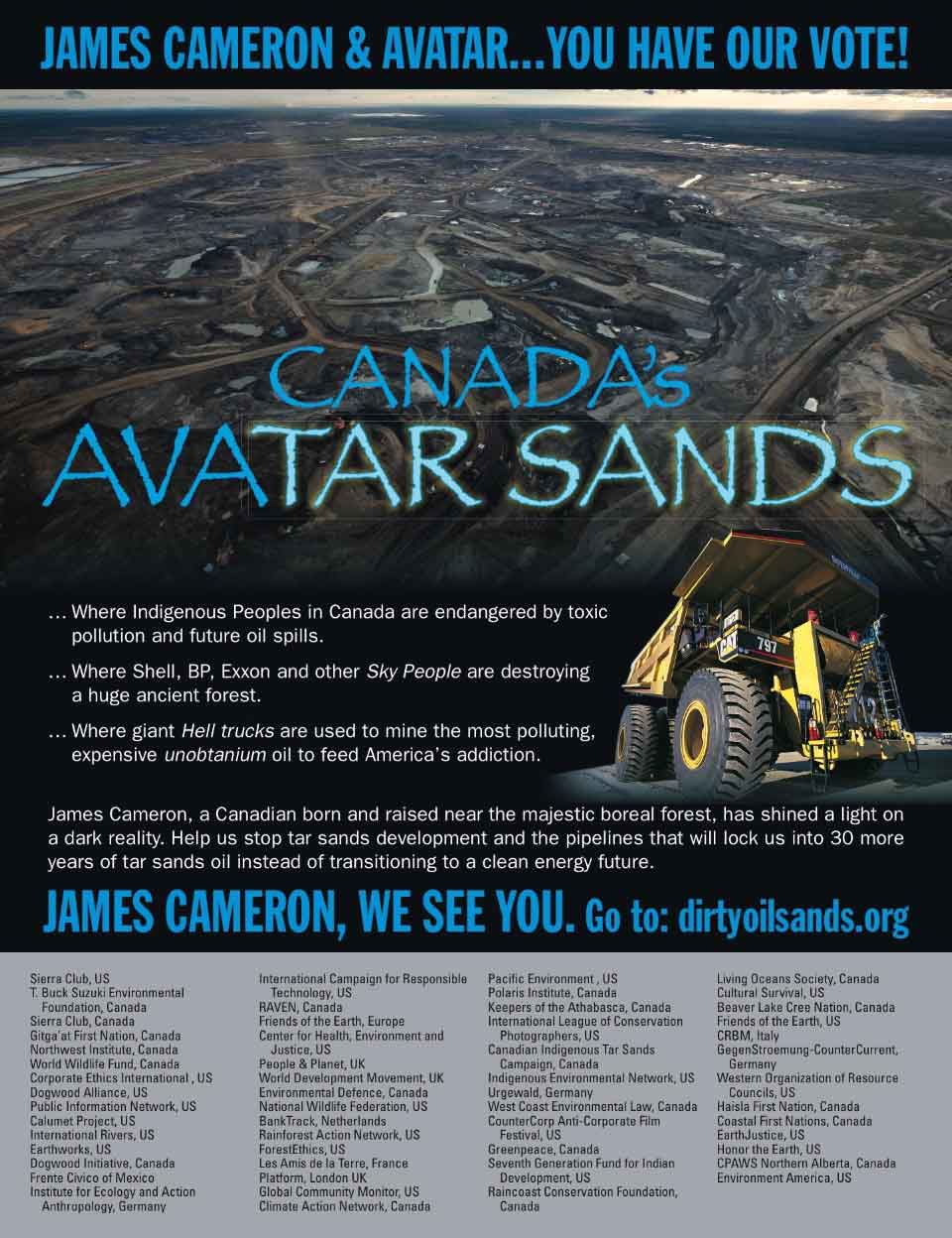
Today in class we had a bit of a surprise. Waiting in the hallway was CBC news reporter Mychaylo Prystupa, and as Kristina announced, to interview class members on an issue called "AVATAR SANDS". It is a group of environmentalists that are comparing the message in the movie Avatar to that of the Alberta Oil Sands, and they are hoping to rally the vote for the Oscars for Avatar to win. Their thoughts are that if Avatar wins, it will spread the environmental message behind the movie Avatar, specifically for the Alberta Oil Sands. This was a SUPER different surprise, and it was kind of fun! Also, I was one of the few students that made it on the news excerpt. :) Aside from that, it was a topic of great interest, regardless of director James Cameron's intentions. The comparison of the "Unobtainium" mining sites to the sites in Alberta are visually uncanny, as well as the devastation to the landscapes,wildlife, and even human health. I think it is great that environmentalists and Aboriginal groups are using the popularity of Avatar to bring a fresh public view of the nastiness of the Alberta tar sands. Hopefully their efforts result in a renewed battle against the oil industries.

http://www.cbc.ca/video/#/News/Local_News/Manitoba/ID=1433027983

Thursday, March 4, 2010

GMO's

Without thinking about the food we eat, we probably consume a lot of genetically modified foods and not even realizing it. How are they affecting us? How HAVE they affected us? My mom always joked that the breast enhancements for McDonalds chickens probably caused a certain age of women to have bigger breasts because of McDonalds consumption. I laughed, but now I think that similarities to that theory could be possible. How do we know that what is being used to modify the animals we eat, isn't going to effect us in some freaky similar way? The problem is that we can't always get quick, cheap access to fresh organic groceries. We want what's easy, and that's how we have been bred this last 20 years and it's unfortunate. I am even having a hard time unwinding that now natural instinct to just get what's easy and it can be a struggle. Admittedly, ease wins.

Monday, March 1, 2010

Shell and Environmental Sustainability


I recently caught a blip of a commercial for the Shell corporation. They were talking about how they are becoming environmentally sustainable, including returning mined sites back to a state of "normalcy", restoring some sort of natural habitat.

Further investigation on their website shows that they even have invested in wind turbines. I'm not too sure if they are for providing energy to others or for their own use, but I'm not sure if it's a gimmick or not? Sort of a marketing ploy, maybe? Perhaps trying to look as sustainable as possible so that people ignore the pollution and damages to the landscapes and environment? From their site, they are advertising many changes and concerns with CO2 emissions and loss of biodiversity. I am having mixed feelings, because as I said before, is it true concern or a deflection to what harm they are really doing? It's like a combination of an environmentalist website and an oil company website. They almost make you forget you are on Shell petrochemical website. However, they do advertise as Shell part of a group of "energy and petrochemical" companies, which brings some understanding to their wind turbines.

I need to check further on what EXACTLY they are doing to restore habitats. On the website it appears as though they do put great efforts in "giving back" to the environment. Is it a facade? I'm not sure what my thoughts are on that yet. If they are truly concerned for the environment, then they are innovators in the oil industry. Yet, they are still an oil/fuel intustry. Are their current efforts enough to offset the damages they are causing?
Image taken from http://www.shell.ca/