Not your typical documentary, but it does the job to get the message across. Again, we are talking about another resource that people take for granted. Water is THE most important resource to us, as our bodies are composed of it and it is needed to survive. Beyond the water itself is a vast array of marine wildlife, another resource which we depend on--fish. Like mentioned in the documentary, if you cannot eat the fish in a lake, then there is a major problem (if there are even any fish left). People (myself included) do not realize how important the Great Lakes are and that their destruction is an indicator as to the bigger picture. Wetlands that surround the Great Lakes are hugely important and vital to the Great Lakes acting as natural filters and protection for fish reproduction. Introduced invasive species are next to impossible to remove, meaning once they have made their way into the Great Lakes, they are there to stay.
I was a little surprised to hear that the Great Lakes are actually decreasing due to increased evaporation. With less rain and snowfall, the water levels are going down. Though that opposes the theory of climate change causing sea levels to rise, it is still a huge indicator that climate change is incredible serious. Also, on top of sea level changes due to other "unseen" causes, dredging the lake floors to deepen them for ships is happening which seems crazy! How are they doing this in a way that marine life is not effected? And speaking of marine life, the fact that there are "intersex" frogs being found with male and female sex organs, as well as alteration of fish from male to female seems astounding. Considering the acceleration of everything on Earth, who knows how long it will be until we are seeing increased number of human babies born intersex? (Above any natural occurrences).
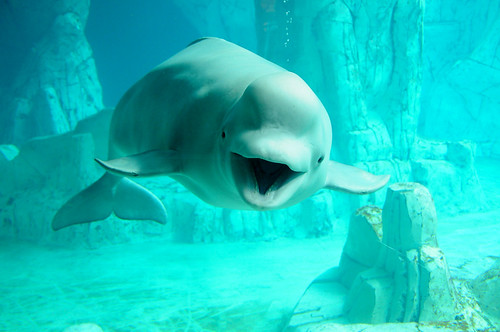
Lastly, I felt that it was hardest to watch the excerpt on the St. Lawrence Beluga whales. I had never heard that they were considered an endangered species, but hearing that they are the number one most contaminated marine animal in the world is astounding. 1/4 of adult females are dying from cancer. CANCER. Beluga whales can get cancer? I find it horrible that our poor pets like dogs and cats can develop cancer, but Beluga whales? These mammals are caught in a vicious cycle, as in the documentary they said that mother whales are passing down the contaminates to baby whales, which are then introduced to new contaminants mixing with the old...it is only a matter of time before the thousands of Beluga whales become hundreds.
Where does it all end? I have found that upon entering the Environmental Studies program I have learned of horrors beyond horrors. As concerned as I was for recycling, animals, the air we breath etc, I was blind to the deeper problems. And people do not care. I find that co-workers and even family members humour me when I pull cardboard out of the garbage and lecture on recycling. Then everybody gets proud because we are recycling so much now. Recycling is a start, but it is not enough. My common dilemma is the constant thoughts running through my head. It is tiring reading label after label, and trying to really go deeper into where the products I am consuming are coming from. That is why people don't care, because it is currently "work" to care. If everything started from the roots (ie, corporations, industries, manufacturers, etc) making almost everything eco-friendly, eco-choice, etc, then making the right decision could get easy. It is great that being "green" is somewhat of a trend, but until it really takes off to almost all of the products we regularly consume then "eco" will still cost more money than "non-eco" and so on. Maybe it is like anti-smoking campaigns. Frighten people into stopping smoking with commercials of people who have just barely survived cancer with part of their face missing. Yes, there are a lot of popular films out there like "An Inconvenient Truth" that do try and install that fear into people, but maybe it should be on cartons as well. Or on packaging for companies refusing to use recycled plastic or promote recycling. Maybe a picture of a decomposing bird with 500 bottle caps inside it's carcass.
I guess the answer is to keep trying. That is why I am in this program. I think maybe one person can make a difference. And if 500 people think that exact same thing, then we have 500 people making a difference, and so on. Even though at times I get the feeling of defeat, it is something that just adds to my "To Do" list in life. The Beluga whale in the documentary almost looked as if it was smiling, even though it may have riddled with cancer. It doesn't deserve to inherit our diseases, as much as our children don't deserve so. Positivity is key, no matter the grimness of what is going on in the world right now.
I was a little surprised to hear that the Great Lakes are actually decreasing due to increased evaporation. With less rain and snowfall, the water levels are going down. Though that opposes the theory of climate change causing sea levels to rise, it is still a huge indicator that climate change is incredible serious. Also, on top of sea level changes due to other "unseen" causes, dredging the lake floors to deepen them for ships is happening which seems crazy! How are they doing this in a way that marine life is not effected? And speaking of marine life, the fact that there are "intersex" frogs being found with male and female sex organs, as well as alteration of fish from male to female seems astounding. Considering the acceleration of everything on Earth, who knows how long it will be until we are seeing increased number of human babies born intersex? (Above any natural occurrences).
Lastly, I felt that it was hardest to watch the excerpt on the St. Lawrence Beluga whales. I had never heard that they were considered an endangered species, but hearing that they are the number one most contaminated marine animal in the world is astounding. 1/4 of adult females are dying from cancer. CANCER. Beluga whales can get cancer? I find it horrible that our poor pets like dogs and cats can develop cancer, but Beluga whales? These mammals are caught in a vicious cycle, as in the documentary they said that mother whales are passing down the contaminates to baby whales, which are then introduced to new contaminants mixing with the old...it is only a matter of time before the thousands of Beluga whales become hundreds.
Where does it all end? I have found that upon entering the Environmental Studies program I have learned of horrors beyond horrors. As concerned as I was for recycling, animals, the air we breath etc, I was blind to the deeper problems. And people do not care. I find that co-workers and even family members humour me when I pull cardboard out of the garbage and lecture on recycling. Then everybody gets proud because we are recycling so much now. Recycling is a start, but it is not enough. My common dilemma is the constant thoughts running through my head. It is tiring reading label after label, and trying to really go deeper into where the products I am consuming are coming from. That is why people don't care, because it is currently "work" to care. If everything started from the roots (ie, corporations, industries, manufacturers, etc) making almost everything eco-friendly, eco-choice, etc, then making the right decision could get easy. It is great that being "green" is somewhat of a trend, but until it really takes off to almost all of the products we regularly consume then "eco" will still cost more money than "non-eco" and so on. Maybe it is like anti-smoking campaigns. Frighten people into stopping smoking with commercials of people who have just barely survived cancer with part of their face missing. Yes, there are a lot of popular films out there like "An Inconvenient Truth" that do try and install that fear into people, but maybe it should be on cartons as well. Or on packaging for companies refusing to use recycled plastic or promote recycling. Maybe a picture of a decomposing bird with 500 bottle caps inside it's carcass.
I guess the answer is to keep trying. That is why I am in this program. I think maybe one person can make a difference. And if 500 people think that exact same thing, then we have 500 people making a difference, and so on. Even though at times I get the feeling of defeat, it is something that just adds to my "To Do" list in life. The Beluga whale in the documentary almost looked as if it was smiling, even though it may have riddled with cancer. It doesn't deserve to inherit our diseases, as much as our children don't deserve so. Positivity is key, no matter the grimness of what is going on in the world right now.
Image taken from http://farm4.static.flickr.com/3204/3088444269_4cd35a9f74.jpg


